Dynamic simulation of skeletal-muscle energy metabolism.
Phosphocreatine, glycolysis, and oxidative phosphorylation coupled in a single ODE system. Set an athlete profile, choose an exercise protocol, and run the simulation.

Based on the Mader model of skeletal-muscle energy metabolism

Dedicated to Prof. Dr. med. Alois Mader and Prof. Dr. med. Hermann Heck
Pioneers of mathematical modelling of muscle energy metabolism

Scope of this software

MetaboliSim implements a simplified, mechanistic model of skeletal-muscle energy metabolism (Mader 2003). It covers the central biochemical reactions of the three ATP-resynthesis pathways and their coupling to exercise intensity, pH, and substrate availability.

Simulations reproduce qualitative patterns such as PCr depletion, lactate threshold shifts, and VO₂ on/off-kinetics. Absolute values may differ from experimental measurements. This software is intended for research and education.

1

Set the Athlete

Body mass, active muscle fraction, VO₂max, and vLamax define the metabolic profile. Select a preset or enter custom values.

2

Choose Exercise

Constant load, step test, ramp, intervals, sprint, sine wave, or import your own power file.

3

Run

The ODE system is integrated numerically (4th-order Runge–Kutta). Results appear within seconds.

4

Analyze

Interactive multi-axis plots, energy contribution breakdown, and one-click Excel / CSV export.

Guided Examples

Four exercise scenarios with increasing complexity. Click to load the parameters and run.

① Wingate Sprint
30 s all-out · Max Effort · + 60 s recovery

A 30-second maximal sprint. PCr drops from ~20 to near 0 mmol/kg while ATP remains almost constant, buffered by the creatine kinase equilibrium. Power decays as glycolysis becomes the dominant ATP source.

You’ll see: PCr depletion, ATP homeostasis, exponential power decay, glycolysis peaking at ~10 s, start of PCr recovery.

② Threshold Ride
200 W constant · 30 min · near MLSS

Constant load near the lactate threshold. Blood lactate rises in the first minutes, then stabilises at or below MLSS. The muscle-to-blood lactate gradient reflects monocarboxylate transport kinetics.

You’ll see: VO₂ slow rise to plateau, lactate steady state, muscle → blood gradient, pH drop and stabilization.

③ HIIT Intervals
5 × 3 min @ 300 W · 2 min @ 100 W

Intervals above critical power with incomplete recovery. Each bout drives PCr lower and lactate higher. The two-compartment model shows how muscle and blood lactate diverge during rapid load transitions.

You’ll see: Stacking metabolic stress, incomplete PCr recovery, lactate staircase, VO₂ on/off asymmetry.

④ Step Test + Recovery
50 W start, +50 W / 3 min · to exhaustion + 10 min EPOC

Graded exercise test to exhaustion, followed by 10 min passive recovery showing EPOC and lactate clearance. Simulation time exceeds exercise duration. Uncheck “Auto” to adjust this manually.

You’ll see: Progressive PCr decline, exhaustion, EPOC (fast + slow), lactate clearance, asymmetric VO₂ off-kinetics.

The Three Energy Systems

Skeletal muscle resynthesises ATP through three pathways, each with distinct rate and capacity characteristics.

Phosphocreatine

The creatine kinase reaction transfers a phosphate group from PCr to ADP within milliseconds. Limited store (~20 mmol/kg), sufficient for approximately 6–10 s at maximal effort. Resynthesised aerobically during recovery.

Anaerobic Glycolysis

Rapid ATP production from glycogen degradation, peaking at approximately 10–30 s. Lactate and H⁺ accumulate and progressively inhibit the pathway through pH-dependent enzyme inhibition.

Oxidative Phosphorylation

Mitochondrial oxidation of fat and carbohydrate yields ATP at high rates but requires approximately 30 s to reach full activation (VO₂ on-kinetics). Dominant pathway beyond ~90 s. Upper limit determined by VO₂max.

Custom Scenarios

All parameters in the Simulation tab are fully configurable: athlete profile, exercise protocol, glycogen stores, and simulation mode. The PNAS Scenario Presets dropdown provides 35 pre-configured parameter sets corresponding to published experimental conditions.

Scientific basis: Mader A (2003) Glycolysis and oxidative phosphorylation. Eur J Appl Physiol 88:317–338 · Heck H, Bartmus U, Grabow V (2022) Laktat. Springer, Chapter 4
Simulation Results
Import / Export
Two columns: time (s) and power (W). Header optional. Comma / semicolon / tab.
Export Results
Summary

This simulator implements the mathematical model of skeletal-muscle energy metabolism by Mader (2003), extended by the two-compartment lactate model of Heck, Bartmus & Grabow (2022) and glycogen-dependent glycolysis regulation (Neubig 2021).

State variables: Global phosphate potential (ATP + PCr), V̇O2, muscle lactate, blood lactate, muscle glycogen. Integration: 4th-order Runge–Kutta, dt = 0.1 s.

References

Implementation: Dunst AK, Scharf C, Hesse C. MetaboliSim: a Python implementation of the Mader model for dynamic and steady-state simulation of muscular energy metabolism. In preparation.

Validation: Rothschild J, Axsom J, Wackerhage H, Dunst AK, Heck H et al. A mathematical model of human energy metabolism simulates key metabolic exercise phenomena. Under review.

Model theory: Mader A (2003) Eur J Appl Physiol 88:317–338. Heck H, Bartmus U, Grabow V (2022) Laktat, Ch. 4. Springer. Neubig T (2021) MSc thesis, University of Leipzig.

Energy System Contributions

Three parallel ATP sources power skeletal muscle: oxidative phosphorylation, anaerobic glycolysis, and PCr hydrolysis via creatine kinase. PCr acts as a temporal buffer, covering the instantaneous deficit when aerobic + glycolytic ATP production cannot yet meet demand (Mader 2003; Heck et al. 2022).

Oxidative PhosphorylationPCr (Lohmann Reaction)Anaerobic Glycolysis
Simulation Plot
Pathway Details
Pathway Overview
Oxidative Phosphorylation

Mitochondrial ATP resynthesis. ADP-activated, limited by VO₂max.

O2 = O2max × [ADP]2 / (Ks1 + [ADP]2)
Anaerobic Glycolysis

ATP from glycogen. ADP-activated, pH-inhibited.

vLa = vLamax × f(ADP) × f(pH)
Phosphate Balance

GP = ATP + PCr. Oxidative and glycolytic supply minus contractile demand.

d[GP]/dt = O2·bVO₂ + vLa·bVLa − Pdemand − Prest
Steady-State Analysis

Steady-state analysis of the Mader model (2003) as described by Heck et al. (2022, §4.3), extended with glycogen regulation (Neubig 2021). The algebraic 1-compartment curves and the dynamic 2-compartment step-test simulation identify the Maximal Lactate Steady State (MLSS).


Implementation: Dunst AK, Scharf C, Hesse C. MetaboliSim: a Python implementation of the Mader model […] In preparation.

Model theory: Mader A (2003) Eur J Appl Physiol 88:317–338. Heck H, Bartmus U, Grabow V (2022) Laktat, Ch. 4, Springer. Neubig T (2021) MSc thesis, University of Leipzig.

Oxidation and Glycolysis Characteristics
CHEP Equilibrium System and −ΔG_ATP
High-Energy Phosphates vs. Metabolites
Current Parameters
Reference Values

Thermodynamic foundations of the Mader model (2003): ADP-dependent activation characteristics, coupled high-energy phosphate (CHEP) equilibrium, and the energy state of the muscle cell.


Implementation: Dunst AK, Scharf C, Hesse C. MetaboliSim: a Python implementation of the Mader model […] In preparation.

Model theory: Mader A (2003) Eur J Appl Physiol 88:317–338. Heck H, Bartmus U, Grabow V (2022) Laktat, Ch. 4, Springer.

Editable Parameters


Complete Initial State
Thermodynamics
Phosphate Pools
CHEP Equilibrium
Oxidative Phosphorylation
Glycolysis
Lactate Resynthesis
Lactate Kinetics
Buffering & Thresholds
ATP Demand Mapping
Sprint / Max-Effort

Apply or Reset
Scientific Descriptions of Model Constants

User Guide

Dynamic and steady-state simulation of skeletal-muscle energy metabolism during exercise.

What can I do with this tool?

MetaboliSim Origin computes the dynamic response of the three ATP-resynthesis pathways to a given exercise protocol and athlete profile.

Performance Analysis
Find your MLSS
→ Steady-State tab
Analyze a sprint
→ Simulation tab
Training Design
Compare intervals
→ Simulation tab
Glycogen depletion
→ Simulation tab
Research & Validation
Simulate running
→ Exercise Mode
PNAS figures
→ PNAS Scenarios

Quick Start

Your first simulation in 60 seconds

Example: simulate a 5-minute threshold effort and observe the time courses of lactate, PCr, and VO2:

  1. 1Pick an athlete

    Open the Simulation tab. Select an Athlete Preset (e.g. Trained: 72 kg, VO2max 55, vLamax 0.3). Or enter your own values.

  2. 2Set the workout

    Choose Constant Load at 200 W for 5 minutes. Or try a Step Test to see the full lactate curve.

  3. 3Run

    Click Run Simulation. Results appear within seconds.

  4. 4Analyse the results

    The multi-axis plot displays power, PCr, lactate, and additional variables simultaneously. Toggle variables with checkboxes. Switch to Energy Contribution for a pathway breakdown.

Tip The Welcome tab provides pre-configured examples (Wingate Sprint, Threshold Ride, HIIT, Step Test) that load all parameters automatically.

Common Use Cases

What question are you trying to answer?

Determine MLSSOpen Steady-State, enter athlete data, click Run Step Test. Identifies the highest power output at which blood lactate reaches a steady state.
Analyse a sprintIn Simulation, choose Sprint (30 s Wingate), set Max Effort. Shows PCr depletion, lactate accumulation, and power decay.
Compare interval protocolsSelect Intervals, run the simulation, modify the protocol, and run again. Compare lactate, PCr recovery, and glycogen consumption.
Simulate glycogen depletionSet glycogen to 5 g/kgm (depleted) vs. 15 g/kgm (loaded). Reduced glycogen lowers glycolytic rate and advances exhaustion.
Running modeChange Exercise Mode to Running (m/s) or Running (km/h). Inputs switch to speed and the model applies running-specific VO2 coefficients.
Reproduce published figuresSelect a PNAS Scenario from the dropdown. Loads the exact parameter set for each figure. Parameters can be modified and re-run.

Navigation

The four main tabs

Simulation
Dynamic time-course analysis

Define an athlete profile and exercise protocol. The solver computes PCr, VO₂, lactate, and glycogen over time.

Athlete Profile: Body mass, active muscle mass, VO₂max, vLamax. Quick presets available.
Exercise Profile: 7 types: Constant, Step Test, Ramp, Intervals, Sine, Sprint, File Import.
Simulation Mode: Abort on Exhaustion (PCr/glycogen limit), Energy Limited (auto-reduce power), Max Effort (sprint decay).
Recovery: Passive or active recovery after exercise. Models excess post-exercise oxygen consumption (EPOC) and lactate clearance.
Energy Contribution: Stacked breakdown: oxidative, glycolytic, PCr-derived ATP.
Advanced Model: Toggles for sigmoid glycogen→VLamax (Neubig 2021) and VO₂max glycogen floor.
Steady State
Thresholds and equilibrium

Lactate–power relationship at metabolic equilibrium.

vLass: Steady-state lactate production rate.
vLaox: Max rate the muscle can burn lactate as fuel.
La(b) SS: Classic blood lactate–power curve.
Fat Ox %: Fat vs. carbohydrate oxidation share.
Run Step Test: Finds MLSS via full dynamic simulation.
Metabolic
Thermodynamic foundations

The phosphate equilibrium underlying the model.

Activation Curves: VO₂ and glycolysis response to ADP across pH levels.
CHEP Equilibrium: Phosphate recycling (CK + AK): ATP, ADP, free energy.
Energy State: Phosphate pool composition, rest to exhaustion.
Configuration
Model parameters

Direct access to all model constants.

Initial Values: Starting PCr, lactate, VO₂, time step.
Constants: 50+ model parameters. Edit, apply, or reset to defaults.
Changing constants can produce unrealistic results. Only modify values you understand.

Key Concepts

Not required, but helpful for interpreting results

VO₂max
Maximum rate of oxygen uptake; upper limit of aerobic ATP resynthesis.
Endurance athletes: 60–80 ml/min/kg.
vLamax
Maximum glycolytic lactate formation rate (mmol/L/s, referred to blood volume).
Sprinters: 0.6–1.0 mmol/L/s. Endurance: 0.2–0.4 mmol/L/s.
PCr
Phosphocreatine. Immediate phosphate donor for ATP resynthesis via creatine kinase.
~20 mmol/kg at rest. Depleted within seconds at maximal effort; recovery t½ ≈ 30–60 s.
MLSS
Maximal Lactate Steady State.
Highest exercise intensity at which blood lactate concentration stabilises.
Active Muscle Mass
Fraction of body mass that is metabolically active during the exercise.
Cycling: 24–30%. Running: 28–35%.
Glycogen
Intramuscular substrate for glycolysis.
Normal: 12–16 g/kgm. Depletion reduces glycolytic rate and advances exhaustion.

Import & Export

Import a power fileSelect File Import. Upload a CSV with two columns (time in seconds, power in watts). Delimiters are detected automatically.
Export resultsAfter running, click Download Excel or Download CSV. The export contains all computed variables.
Export from other tabsThe Steady-State and Metabolic tabs each provide Export CSV.

Troubleshooting

Plot is empty after running
Power and duration must both be > 0. Step tests require at least one step.
Simulation stops immediately
Initial PCr or glycogen may be too low, or the prescribed power exceeds capacity. Reduce power or increase glycogen.
Unrealistically high lactate
Verify vLamax and power settings. If model constants were modified, click Reset to Defaults.
Simulation takes a long time
Durations above 1 h or time steps below 0.01 s increase computation time. Increase dt or shorten the duration.
CSV import fails
The file must contain two numeric columns (time in s, power in W). A header row is acceptable.

How the Model Works

The big picture (details in each tab's Scientific Background section)

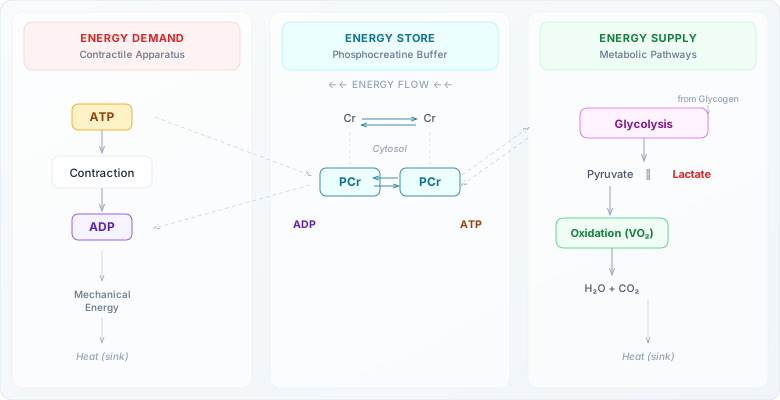
Energy flow: Demand ← PCr Store ← Supply (glycolysis + oxidation)

Energy flows from supply to demand: glycolysis and oxidative phosphorylation regenerate PCr, which buffers the ATP/ADP ratio required for muscle contraction.

Five state variables are integrated over time: global phosphate potential (PCr + ATP), VO₂, muscle lactate, blood lactate, and glycogen. For equations and references, see Scientific Background at the bottom of each tab.

MetaboliSim Origin © 2026 · AGPL-3.0-or-later · Dunst, Scharf & Hesse (in prep.) · Mader (2003) · Heck et al. (2022)